Galápagos Restore Galápagos Made

Santa Cruz Island · Galápagos

This is
conservation.
It is also
a souvenir.

Galápagos Restore produces artisan resin objects made from Polistes versicolor — a social wasp invasive to the Galápagos Archipelago since 1988. Each piece is trapped, preserved, and documented on Santa Cruz Island. Every purchase removes one more individual from the ecosystem.

Polistes versicolor yellow paper wasp preserved in UV-cured resin dome, artisan-made on Santa Cruz Island, Galápagos

The species

Polistes versicolor

Introduced to the Galápagos from mainland South America around 1988, P. versicolor is now established across all five main islands. It builds paper nests on any surface in any habitat. In the Galápagos it has no natural enemies. No eradication method currently exists.

Live Polistes versicolor wasps entering an attractant trap, Galápagos dry zone with lava rock and Opuntia cactus

Attractant trap, private agricultural land, Santa Cruz Island. 0.6887°S, 90.3106°W.

329 mg
of native insects consumed per colony per day — competing directly with 15 endemic bird species, 9 gecko species, and 9 lizard species for food
93
Galápagos plant species visited — 66 endemic or native — disrupting pollination networks that evolved over millions of years
Active
joint research programme between the Charles Darwin Foundation and the Galápagos National Park Directorate, developing species-specific chemical lures for population control
Systematic wasp monitoring station with stacked attractant traps in a Galápagos forest

Stacked monitoring station, highland forest, Santa Cruz Island.

How it works

Three steps. One economic logic.

Step 01 — Trap

Caught on private land

Yellow attractant traps are installed on private agricultural land in Puerto Ayora, Santa Cruz Island. Each site is GPS-logged. Traps are checked weekly. Specimens are collected with exact coordinates and date recorded. No National Park permit is required — this activity takes place entirely outside Galápagos National Park territory.

Step 02 — Preserve

Made into an object

Specimens are dried with silica gel desiccant for 1–2 weeks. Each is positioned in a silicone mold and embedded in UV-cured epoxy resin in sequential layers, with each layer cured before the next is poured. Finished pieces are sanded and polished to optical clarity. Each receives a printed GPS label and a QR code.

Step 03 — Sell and educate

The story travels

Products are sold to tourists and residents on Santa Cruz Island. The QR code on each piece leads to a page showing the species, its ecological impact, the exact capture location, and what the purchase funded. The object carries that story out of Galápagos and into homes, classrooms, and conversations worldwide.

The collection

Five product types. One species.

Five oval resin specimens: Queen, Worker spread, Worker folded, Drone, Nest Fragment — each labeled with specimen number and collection coordinates
001

Queen

Largest specimen. Foundress of the colony.

002

Worker — wings extended

Full wingspan visible. Translucent wings, segmented abdomen.

003

Worker — wings folded

Compact. The form most visitors encounter in the field.

004

Drone

Male. Slightly smaller. Longer antennae.

005

Nest Fragment

Section of paper nest. Grey hexagonal cells. No specimen.

Every piece carries a QR code linking to its individual collection record: GPS coordinates, date, collector identity, species profile, and conservation impact.

Why this works

The income-generating activity and the conservation action are identical.

Every piece sold corresponds to one invasive individual removed from the Galápagos ecosystem. This model inverts the usual problem in conservation economics, where the most ecologically valuable actions generate no income. Here, the economics reinforce the ecology — the more pieces sold, the more is removed.

The craftsperson

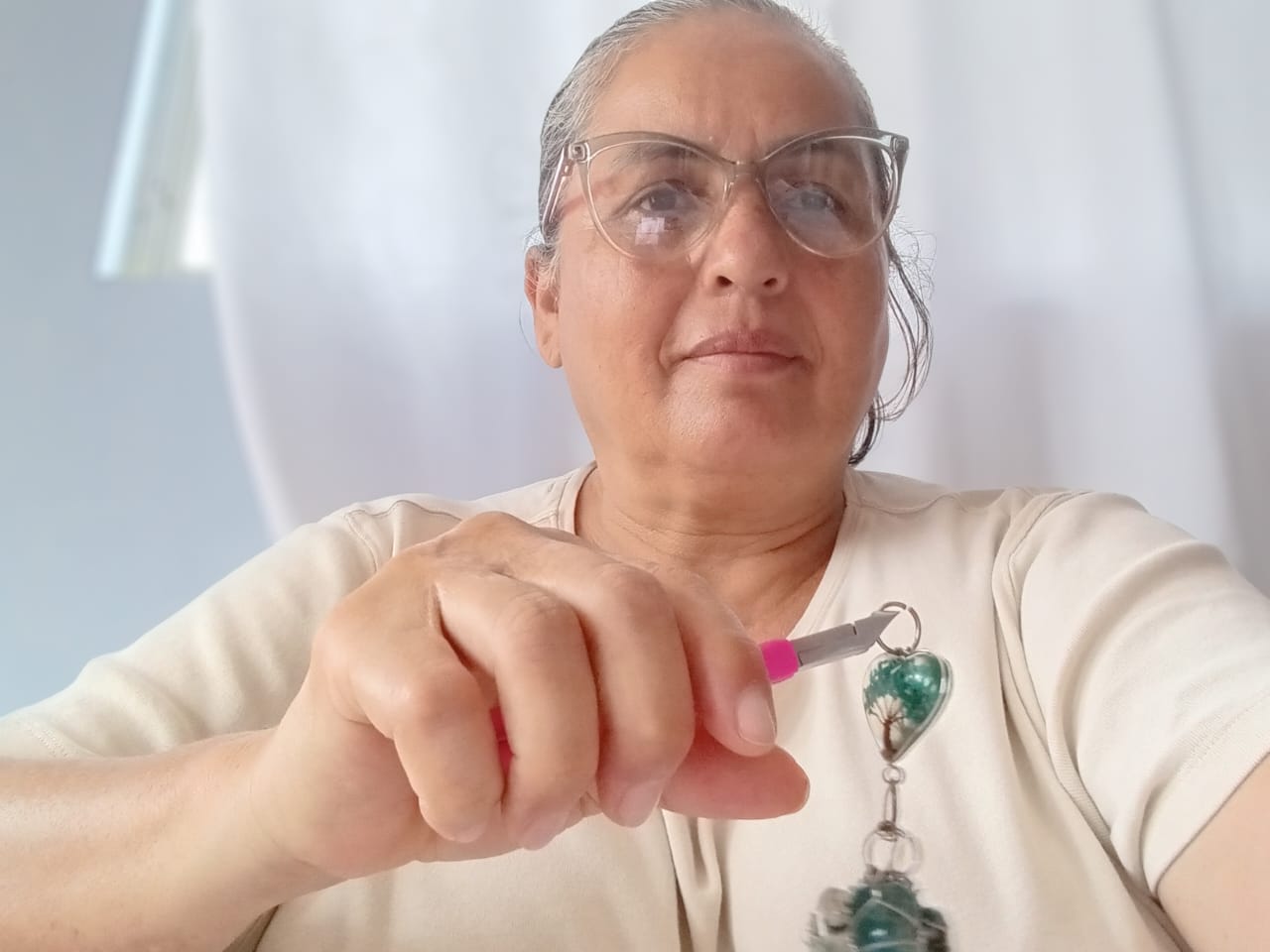
Moncerate Magdalena García Zambrano working at her resin worktable on Santa Cruz Island, Galápagos
Moncerate Magdalena García Zambrano, enterprise lead, Santa Cruz Island

Moncerate Magdalena
García Zambrano

Craftsperson · Enterprise lead

Permanent resident of Santa Cruz Island, Galápagos
Residency No. 2111047 · Barrio Pelicambay, Puerto Ayora

Moncerate manages the trapping sites near her home in Puerto Ayora, produces each piece by hand using UV resin techniques, and oversees sales. She is not a representative of an outside organization. She lives in the community where this problem exists and runs this enterprise herself.

"My family has been on this island for three generations. What happens here is my business."
The enterprise is designed to be fully self-sustaining within 12 months of production launch. Startup costs — equipment, materials, product development, and branding — are the only items that require external funding. Operating costs are covered by sales revenue.

Methodology and references

Peer-reviewed at every step

Bejcek et al. (2018).
J. Insect Sci. 18(2):34.

Demonstrates that UV resin casting of arthropods produces specimens more durable, safer to handle, and more educationally effective than alcohol preservation or pin mounting. In active use at Texas A&M University for entomology courses of 600+ students annually. Provides the methodological basis for the production technique used in this project.

Parent et al. (2020).
Environ. Entomol. 49(6):1480–1491.

Documents Polistes versicolor ecology, life history, colony structure, and ecological impact on Santa Cruz Island. Provides the species-specific data underlying the conservation rationale of this project. Confirms pan trap methodology as used by CDF researchers in the field.

Bulgarella et al. (2022).
J. Insect Sci.

Describes active joint research by the Charles Darwin Foundation and the Galápagos National Park Directorate into semiochemical lures for P. versicolor population management. Confirms ongoing institutional recognition of the species as a priority conservation target and validates the attractant trap methodology.

Follow this project

For information about the project, wholesale inquiries, or press contact.

No spam. Unsubscribe at any time.

Direct contact: hello@galapagosrestore.com